The Hershey Company reported second-quarter 2026 consolidated net sales of $2,787.3 million, a 6.6% increase versus the prior year period, as strategic price realization across its confectionery and salty snacks portfolios more than offset volume softness tied to consumer elasticity. Organic, constant currency net sales grew 3.6%, driven by approximately 12 points of net price realization — a figure that underscores how aggressively the company has leaned on list-price increases and reduced trade spend optimization to rebuild margin after a bruising commodity cycle. For the first half of 2026, consolidated net sales reached $5,891.5 million, up 8.7%, with organic growth of 5.8%.
Confectionery at Shelf
Hershey's North America Confectionery segment — the engine that powers the company's planogram presence across grocery, mass, and convenience channels — generated net sales of $2,173.6 million in Q2, up 4.2% year over year. Organic net sales matched that figure at 4.2%, with roughly 14 points of net price realization powering the gain even as volume fell approximately 10 points, reflecting both elasticity pressure and normal quarter-to-quarter shipment variability. In the 12-week period ended July 19, 2026, Hershey's U.S. candy, mint and gum (CMG) retail takeaway in MULO+ with convenience increased 3.7% — a positive scan-data read for category managers evaluating shelf productivity. CMG market share, however, slipped versus the prior year as competitive innovation intensified, a flag for retailers building out their confectionery planograms heading into the back half. Segment income jumped 40.1% to $705.8 million, with segment margin expanding 830 basis points to 32.5%, fueled by lower net commodity costs and supply chain productivity savings.
Salty Snacks: Growth with a Margin Catch
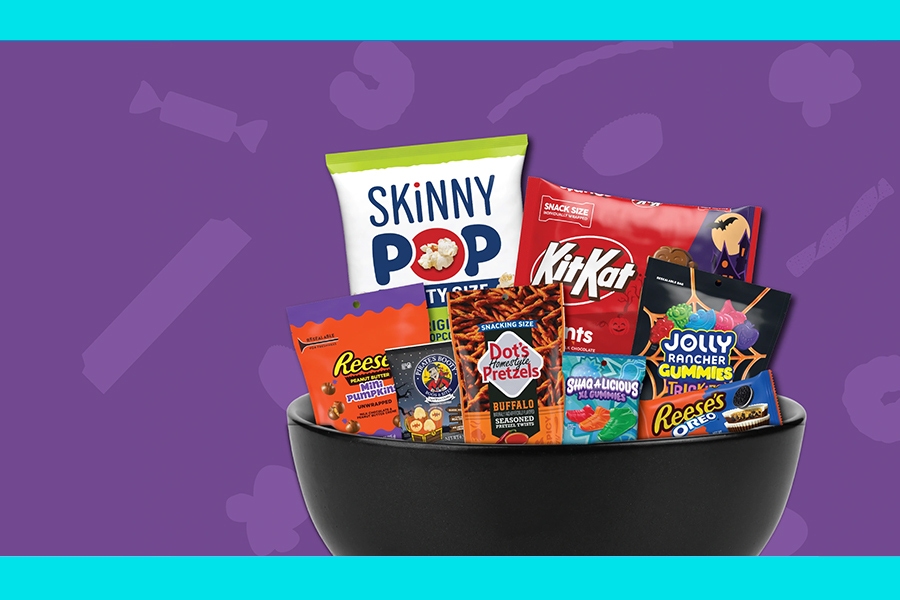
The North America Salty Snacks segment posted the headline number for the quarter — net sales of $387.8 million, up 22.9% — but the complexity beneath that figure matters for category management operators tracking Hershey's shelf-space ambitions. Roughly 22 percentage points of that growth came directly from the 2025 LesserEvil acquisition, which is contributing approximately 150 basis points to full-year net sales growth. Organic, constant currency growth came in at just 0.6%, with volume up approximately 4 points — below internal expectations — as strong innovation-driven velocity gains on new items were partially offset by execution challenges on multipacks and Dot's pretzels. Trade investment behind new item launches created an approximate 3-point net price headwind. Hershey's salty snack retail takeaway in MULO+ with convenience (excluding LesserEvil) rose 6.5% for the 12-week period, lifting market share — but organic net sales trailed that retail takeaway figure due to supply limitations and a deliberate pullback from private label customer sales. Segment income fell 5.9% to $62.6 million, with margin contracting 500 basis points to 16.1%, pressured by higher logistics costs and stepped-up consumer marketing investment.
The International segment posted net sales of $225.9 million, up 5.7% as reported, though organic constant currency growth of 2.1% tells a more constrained story. Elevated raw material and manufacturing costs drove the segment to a $5.1 million loss, down $24.9 million from the prior year period, with margin deteriorating 1,160 basis points to (2.3)%. Demand was stronger than planned in Brazil and the UK, but that momentum was not enough to offset cost headwinds and the depletion of Q1 inventory pre-positioned to manage geopolitical risk.
Outlook and Investment Signals
Hershey narrowed its full-year 2026 guidance, now projecting net sales growth of 4.5% to 5.0% (up from 4% to 5%) and organic net sales growth of 3.0% to 3.5% (up from 2.5% to 3.5%). Adjusted EPS guidance tightened to a range of $8.36 to $8.52, reflecting growth of 32.5% to 35.0% versus 2025. The company expects capital expenditures of $425 million to $475 million and approximately $100 million in savings from its Advancing Agility & Automation Initiative — investments that signal continued commitment to supply chain flexibility as cost visibility improves. The outlook excludes any potential future tariff rebates, a notable caveat for retailers and buyers modeling Hershey's pricing trajectory into holiday confectionery season. President and CEO Kirk Tanner described the company as entering the second half with "compelling growth plans and increased investment behind our brands, merchandising, and innovation," signaling that promotional and in-store display spending is set to intensify even as the company manages dynamic input-cost markets.
Written by Michael Politz, Author of Guide to Restaurant Success: The Proven Process for Starting Any Restaurant Business From Scratch to Success (ISBN: 978-1-119-66896-1), Founder of Food & Beverage Magazine, the leading online magazine and resource in the industry. Designer of the Bluetooth logo and recognized in Entrepreneur Magazine's "Top 40 Under 40" for founding American Wholesale Floral, Politz is also the Co-founder of the Proof Awards and the CPG Awards and a partner in numerous consumer brands across the food and beverage sector.