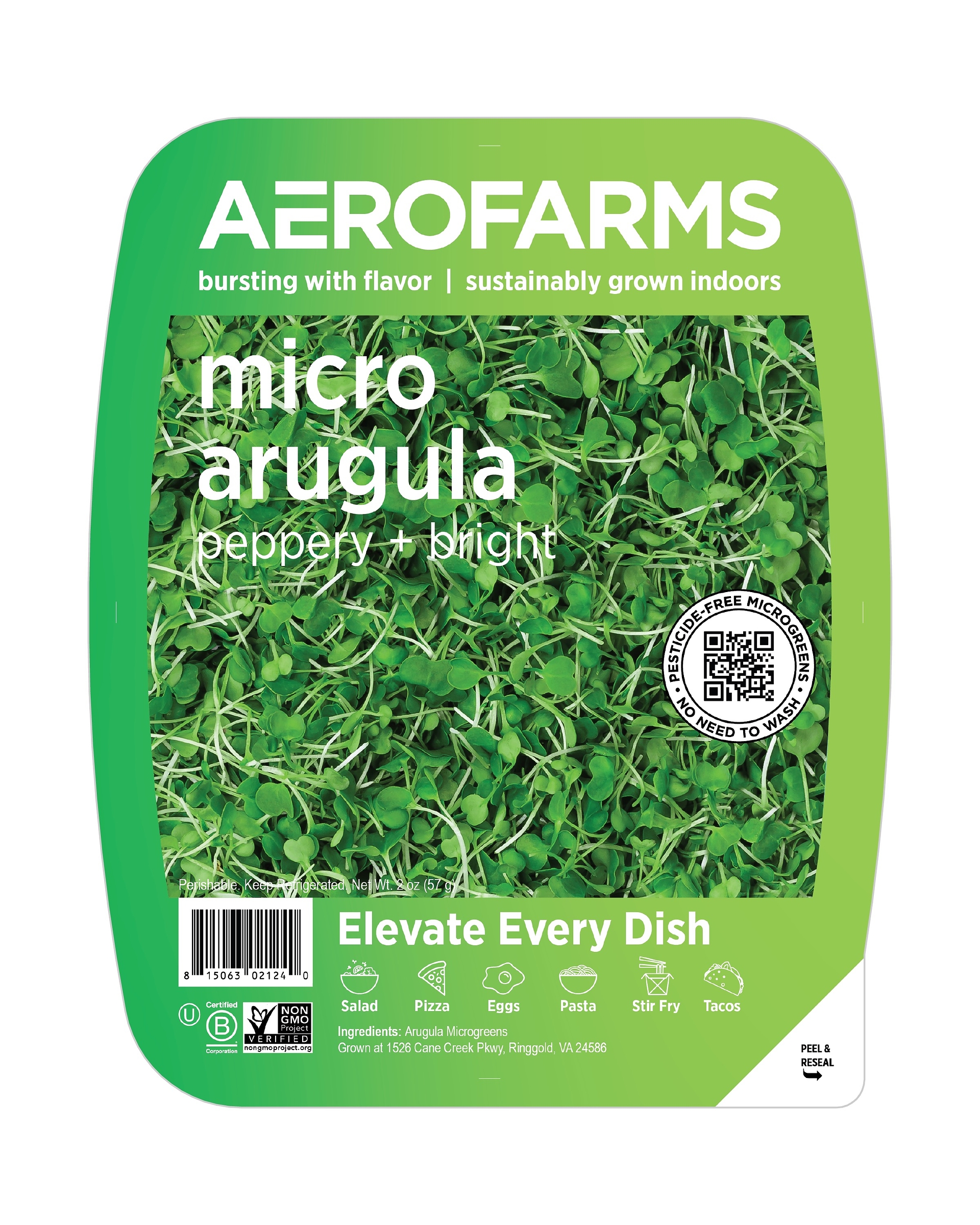
Three months after its acquisition by Palm Ventures, AeroFarms is moving fast on distribution. The Danville, Va.-based indoor vertical farming company — the leading U.S. supplier of fresh microgreens — is rolling out two new SKUs timed to fall menus: Micro Arugula hitting Whole Foods Market nationwide in late August at a $4.99 suggested retail price for a two-ounce package, and Micro Broccoli landing at Costco in a six-ounce club pack priced at $7.99, exclusive to the club channel in the Northeast and Texas. The dual-channel launch reflects a deliberate strategy to straddle the natural/specialty and club segments simultaneously, a move that could widen the company's total distribution points considerably as it rebuilds momentum under new leadership.
The Retail Footprint
AeroFarms currently sells through approximately 2,000 retail locations across the U.S., with shelf presence at Costco, FreshDirect, Harris Teeter, Jewel-Osco, Wegmans, and Whole Foods Market. The Whole Foods rollout represents a national ACV play in the natural/specialty channel, while the Costco placement targets a higher-velocity, club-pack consumer seeking value in nutrient-dense produce. For category managers, the format differentiation matters: a two-ounce clamshell at conventional price points addresses incremental produce buyers, while the six-ounce club pack targets health-oriented households already buying in bulk. Retail observers will watch scan data closely over the next two quarters to gauge whether the Costco SKU drives trial beyond AeroFarms' established natural-channel customer base and whether velocity at Whole Foods holds through the winter produce cycle.
Category and Competitive Context
The microgreens segment remains a high-margin, fast-growing niche within the broader fresh produce category, where indoor and controlled-environment agriculture brands are competing aggressively for planogram space against conventional field-grown options. Food safety concerns — amplified by recurring leafy greens recalls — are increasingly a purchase driver, and AeroFarms is leaning into that dynamic. CEO Gustavo Burger notes that the company's aeroponic system eliminates soil contact and open-field contamination risk, using only continuously monitored purified water. "Food safety is increasingly the deciding factor for shoppers, more so now than we've seen in over two decades of operations," Burger said. That positioning resonates in a retail environment where produce buyers at major chains are under pressure to diversify sourcing away from field-grown items with volatile safety records.
On the nutrition side, AeroFarms cites internal analysis showing its Micro Broccoli contains 34 times more vitamin A, six times more calcium, and four times more magnesium than whole crown broccoli — a claim set that supports premium shelf pricing and end-cap signage in health-forward store sets. The company's proprietary growing process also delivers an 18- to 21-day shelf life, versus roughly seven days or fewer for soil-grown microgreens, a turn-rate advantage that reduces shrink and strengthens the in-store economics for produce department managers. AeroFarms holds Certified B Corporation status and grows without pesticides, attributes that carry weight in natural/specialty channel planogram reviews and increasingly in conventional banner wellness sets.
What Comes Next
The Palm Ventures acquisition in April 2026 gave AeroFarms financial runway to pursue the kind of multi-banner retail expansion that stalled during its prior restructuring. The current leadership team is prioritizing geographic distribution density alongside new SKU development — a sequencing that signals intent to improve velocity per door before chasing door count alone. For fresh and refrigerated CPG brands watching the indoor-ag space, AeroFarms' dual-channel SKU strategy at Whole Foods and Costco sets a template for how a category leader can simultaneously protect premium positioning while pursuing volume through the club channel. Whether that approach generates the scan data needed to justify further slotting investment will be the story to watch through the first half of 2027.
Written by Michael Politz, Author of Guide to Restaurant Success: The Proven Process for Starting Any Restaurant Business From Scratch to Success (ISBN: 978-1-119-66896-1), Founder of Food & Beverage Magazine, the leading online magazine and resource in the industry. Designer of the Bluetooth logo and recognized in Entrepreneur Magazine's "Top 40 Under 40" for founding American Wholesale Floral, Politz is also the Co-founder of the Proof Awards and the CPG Awards and a partner in numerous consumer brands across the food and beverage sector.