[Post Holdings closed fiscal year 2026 with $8.1 billion in net sales and $1,568.9 million in Adjusted EBITDA, a 2.0% gain over the prior year, as improved gross margins at its core consumer brands segment offset volume headwinds in pet food and value-tier ready-to-eat cereal. The St. Louis-based CPG holding company — whose branded and private label grocery portfolio spans Post Consumer Brands, Michael Foods, Bob Evans Farms, and Weetabix — reported operating profit of $837.6 million for the year, up 5.0% from fiscal 2025.
Consumer Brands Scorecard
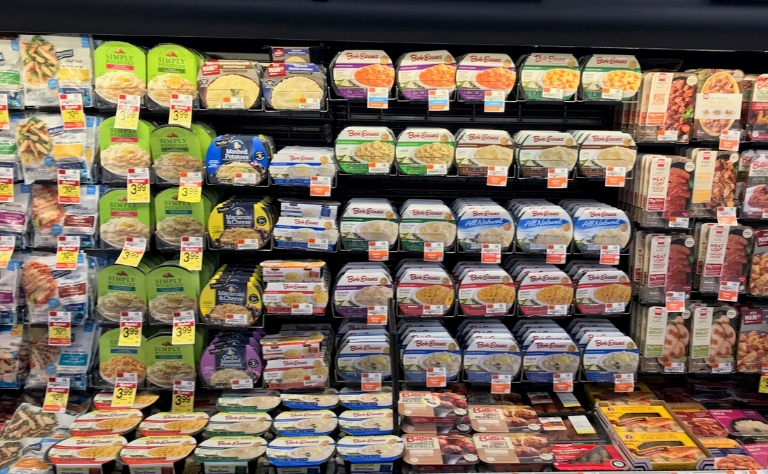
Post Consumer Brands, the company's largest segment and the primary driver of center-store sales across the grocery channel, generated $4.1 billion in full-year net sales, up 2.2% year-over-year after stripping out the December 2025 divestiture of 8th Avenue Food & Provisions' pasta business. Segment profit climbed 10.0% to $543.3 million, and segment Adjusted EBITDA reached $816.2 million — a 2.8% improvement. The operating-margin expansion came even as volumes fell: pet food unit volumes declined 12.7% in the fourth quarter, driven by distribution losses and category softness, while cereal and granola volumes dropped 4.4%, reflecting category-level pressure and planogram resets tied to value-cereal SKU rationalization. For grocery retailers managing RTE cereal and pet food adjacencies on the same aisle, the data signals that branded assortment changes and distribution losses are actively reshaping planogram allocations heading into fiscal 2027.
Foodservice and Refrigerated Retail
Post's Foodservice segment — primarily egg and potato side dish products sold through the foodservice channel — posted full-year net sales of $2.6 billion and segment Adjusted EBITDA of $556.8 million, up 4.5%, even though fourth-quarter results contracted sharply as the company lapped highly pathogenic avian influenza-related pricing from a year earlier. Retail egg and sausage volumes within the Refrigerated Retail segment showed resilience on a comparable basis: excluding the May 2026 divestiture of Crystal Farms Dairy, side dish volumes grew 4.7% and egg volumes rose 4.4% in the quarter, with management attributing side dish gains partly to the introduction of private label offerings — a notable signal for retailers seeking own-brand expansion opportunities in the refrigerated grab-and-go perimeter. Sausage volumes declined 12.7%. The Weetabix segment, covering the U.K. RTE cereal market, grew full-year net sales 2.2% to $554.2 million and improved segment Adjusted EBITDA 11.6% to $138.1 million, with branded products offsetting private label declines.
Capital Priorities and Outlook
Management guided fiscal 2027 Adjusted EBITDA to a range of $1,450 million to $1,500 million — a step down from fiscal 2026's $1,568.9 million — reflecting the absence of divested businesses and continued normalization of egg pricing. Capital expenditures are projected at $360 million to $400 million, with disclosed investment priorities including cage-free egg facility expansion within the Foodservice segment and nut butter manufacturing optimization within Post Consumer Brands. The company spent $1,009.1 million repurchasing 10.3 million shares during fiscal 2026 and carried net leverage of 4.7x as of September 30, 2026. Nicolas Catoggio, President and Chief Executive Officer, and Matthew J. Mainer, Chief Financial Officer and Treasurer, are scheduled to discuss results on a November 20, 2026 conference call.
Written by Michael Politz, Author of Guide to Restaurant Success: The Proven Process for Starting Any Restaurant Business From Scratch to Success (ISBN: 978-1-119-66896-1), Founder of Food & Beverage Magazine, the leading online magazine and resource in the industry. Designer of the Bluetooth logo and recognized in Entrepreneur Magazine's "Top 40 Under 40" for founding American Wholesale Floral, Politz is also the Co-founder of the Proof Awards and the CPG Awards and a partner in numerous consumer brands across the food and beverage sector.