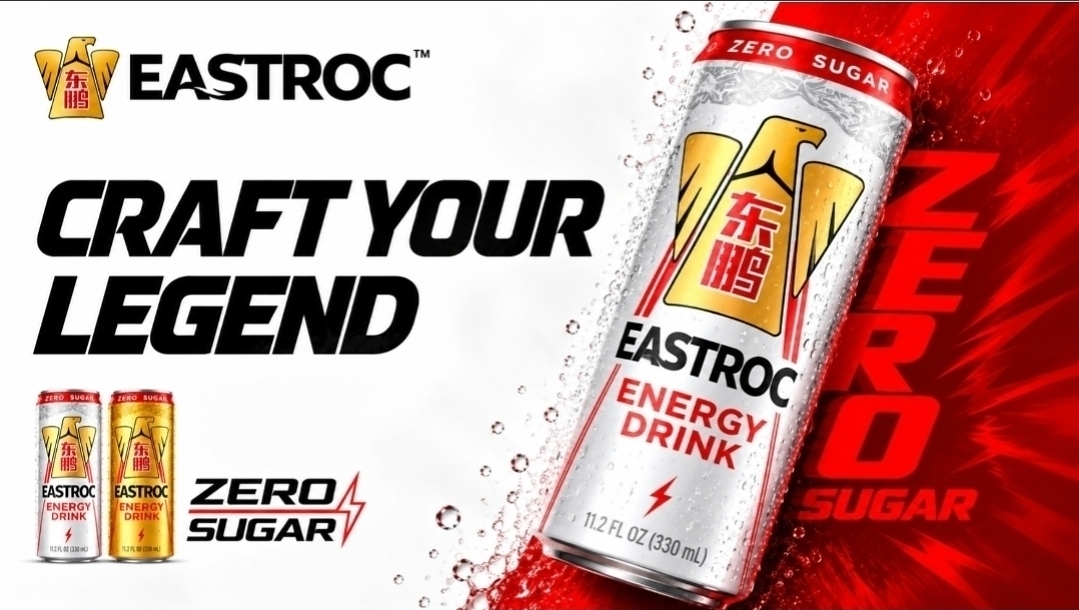
Global energy drink company Eastroc Beverage is entering the U.S. market with two launch SKUs — Gold and White Zero Sugar Energy cans — manufactured through Pittston Co-Packers, an independent beverage co-packer based in Pittston, Pennsylvania. The move marks a significant step in Eastroc's international expansion, extending a footprint that already spans 36 countries and regions from a base of 12 operating production facilities in China.
Leading U.S. commercial development is Joey Nickell, who holds the title of Chief Sales Officer at both Eastroc North America and Pittston Co-Packers. Nickell's background includes senior roles at Coca-Cola and Bang Energy — two organizations that collectively shaped the modern energy drink category's retail playbook. His involvement signals that Eastroc is investing in category-credentialed leadership rather than relying solely on its overseas scale to open doors with U.S. distributors and retail buyers.
Retail Strategy and Distribution
The brand's U.S. entry leans on field sales execution, distributor relationship-building, merchandising support, and consumer engagement — a classic challenger-brand approach in a category dominated by Red Bull and Monster, which together command the overwhelming majority of energy drink ACV across food, drug, mass, and convenience channels. Gaining TDP in that environment requires not just slotting and planogram placement, but sustained velocity to justify continued shelf space allocation. Nickell acknowledged as much, noting that a retail listing is an accomplishment, but consumer repurchase is the real measure of brand viability. Pre-launch consumer touchpoints at FanCon and VidCon were used to generate early trial ahead of broader retail availability, a sampling-forward tactic common among challenger energy brands targeting younger demographics.
Manufacturing and Go-to-Market
Pittston Co-Packers provides Eastroc with a domestic production and quality management infrastructure, a meaningful advantage in an era of supply chain scrutiny and retailer preference for near-shore sourcing. Having U.S.-based co-packing capabilities reduces lead times and simplifies compliance with Food Safety Modernization Act (FSMA) requirements — practical considerations that matter when pitching regional and national grocery chains. For retail partners evaluating a new energy SKU, domestic manufacturing can also reduce the perceived risk of committing floor stack or end-cap support to an unproven import brand.
The energy drink category remains one of the highest-velocity segments in the beverage aisle, with syndicated data consistently showing above-average turns relative to other carbonated soft drinks. That attractive velocity profile draws international entrants regularly, but U.S. shelf space is finite and category captains — typically Monster or Red Bull — exert significant influence over planogram decisions at major grocery and convenience accounts. Eastroc's two-SKU launch keeps the initial assortment tight, a disciplined approach that avoids overextension before the brand has established measurable scan data in domestic markets.
For grocery retailers and distributors evaluating emerging energy brands, Eastroc's combination of global manufacturing scale, domestic co-packing, and experienced U.S. commercial leadership positions it as a more operationally credible entrant than many import brands. Whether that translates to sustained velocity — and earned placement beyond an introductory set — will depend on the execution Nickell has built his commercial thesis around. The beverage category has seen no shortage of international energy brands attempt a U.S. beachhead; Eastroc's path forward runs through distributor alignment, retail sell-through, and the scan data that justifies a permanent planogram slot.
Written by Michael Politz, Author of Guide to Restaurant Success: The Proven Process for Starting Any Restaurant Business From Scratch to Success (ISBN: 978-1-119-66896-1), Founder of Food & Beverage Magazine, the leading online magazine and resource in the industry. Designer of the Bluetooth logo and recognized in Entrepreneur Magazine's "Top 40 Under 40" for founding American Wholesale Floral, Politz is also the Co-founder of the Proof Awards and the CPG Awards and a partner in numerous consumer brands across the food and beverage sector.